Thursday, November 19, 2009

Google Scholar: The Next Westlaw/Lexis Nexis?


Looking for that hard to find court decision or administrative ruling? Maybe it is outside your subscription? Google Scholar may be your answer. Even better...it is free.

http://scholar.google.com/

Simply type in the case and/or citation you are looking for and hit the "Search" button and a list of potential websites with that citation or case will soon appear. Although the service is not perfect, and may not have a lot of specialized holdings, it is a promising tool.

Read more about the service here.

Thanks to WBA Member Christopher Watson for sending this concept to the WBA Blog!

-------------------------------------------------

Thursday, November 5, 2009

The Jefferson Bottles: Fraud in the High Priced Wine World


This articles was written by Patrick Radden Keefe and originally published in the New Yorker.

The most expensive bottle of wine ever sold at auction was offered at Christie’s in London, on December 5, 1985. The bottle was handblown dark-green glass and capped with a nubby seal of thick black wax. It had no label, but etched into the glass in a spindly hand was the year 1787, the word “Lafitte,” and the letters “Th.J.”

The bottle came from a collection of wine that had reportedly been discovered behind a bricked-up cellar wall in an old building in Paris. The wines bore the names of top vineyards—along with Lafitte (which is now spelled “Lafite”), there were bottles from Châteaux d’Yquem, Mouton, and Margaux—and those initials, “Th.J.” According to the catalogue, evidence suggested that the wine had belonged to Thomas Jefferson, and that the bottle at auction could “rightly be considered one of the world’s greatest rarities.” The level of the wine was “exceptionally high” for such an old bottle—just half an inch below the cork—and the color “remarkably deep for its age.” The wine’s value was listed as “inestimable.”


http://www.newyorker.com/reporting/2007/09/03/070903fa_fact_keefe

--------------------------------------------------

Wednesday, November 4, 2009

What Have You Done About Employee Use of Facebook and Twitter?

The following was posted on the Legal Intelligencer Blog by Eric B. Meyer

"A few months ago, I had a blog post about social media policies. I had already developed a few of these policies for clients, as well as our firm’s social media policy. Confident that I knew my stuff, my blog post focused on the rules and restrictions that form the backbone of a great social media policy."


http://thelegalintelligencer.typepad.com/tli/2009/11/what-have-you-done-about-employee-use-of-facebook-and-twitter.html

-------------------------------------------------

Monday, November 2, 2009

Law Practice Management - Discussing Healthcare Options

Let's Discuss Your Healthcare Options...

coffee

Panera Morning

westmoreland bar association

DATE: Wednesday November 4th

TIME: 8:00 - 9:00 am (or so)

LOCATION: Panera Bread, Route 30, Hempfield Plaza


I know you wanted to join us last month for coffee because you really are struggling with all of those nasty issues: bookkeeping, staff, time management, insurance and taxes, but you thought that 7:30am was a little early.

OK, here's your second chance. We are going to get together at 8:00 am, this Wednesday, November 4th at Panera Bread in the Greengate Plaza.

One of the issues we talked about is health insurance so we will have Bob Swann, a health insurance broker available to answer questions. We'll talk about the other stuff too and exchange ideas about good resources.

Mark your calendar, or phone, or PDA and join us.

Come on in.... it is still raining.

Becky Brammell, Co-chair, Law Practice Mngmt Committee


---------------------------------------------------------

Thursday, October 15, 2009

Getting Law Firms to Like Commercials

Maria Aspen of the New York Times tackles the always controversial topic of television advertising.

TELEVISION advertising has long been frowned on in the legal profession, as it can conjure images of ambulance-chasing personal injury lawyers and, in some cases, can run afoul of state laws. But a new partnership between a prominent legal directory and an Internet-based advertising agency is trying to overcome these negatives.

http://www.nytimes.com/2007/06/19/business/media/19adco.html?_r=1

------------------------------------------------

Wednesday, October 7, 2009

Technology Tip: Internet Cookies - Good or Bad?


When you access a website, the site usually (but not always) collects information about your visit, storing it in a small text file on your computer called a cookie. You may even be prompted with a remember me on this website. On each subsequent visit, the website retrieves this information from your hard drive, with the idea of personalizing your visit based on previously expressed preferences or browsing history. After each visit, the cookie is updated and stored again on your hard drive.

Cookies typically contain information such as language preference, previously entered options for number and arrangements of items to display, perhaps the contents of an unfinished shopping cart, and so on. Cookies from legitimate websites do not store information such as login user names or passwords or personal information such as social security numbers or credit card information. Note, however that some websites do use cookies to implement (Keep me logged in or (Remember my password on this computer) features, without actually storing the confidential information within the cookie itself.

Cookies themselves are not harmful; they contain no executable code, cannot become infected, and cookies never run on your computer. They do bring up privacy concerns, however. When you access an Internet site, that website can access ALL of the cookies on your computer, not just the site you're currently visiting. This allows, for example, websites such as Google or Yahoo, to determine which websites you've previously visited in order to customize the display of their own sites. A shopping website may be able to determine recently searched for items from other shopping sites. Websites can also share cookies with each other and read and write each others cookies.

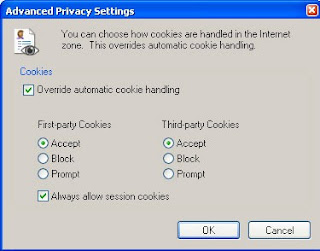
Cookies are easily disabled, but be aware that some Internet pages will not work without them, and some sites will deny you access unless you enable cookies. In Internet Explorer 7 or 8, click on Tools, Internet Options, select the Privacy Tab and then click on the Advanced button. Check the box to override automatic cookie handling, then decide to accept, block, or prompt each time when a website wants to store a cookie on your computer. Note that third-party cookies are created in situations where, for example, you visit msn.com, but the MSN site includes content embedded from another website, and that site (the third-party) stores a cookie on your computer. Session cookies are those that are used while you browse from page to page within a single website - otherwise, you could add items to a store shopping cart (for example) but the items would be gone by the time you¹re ready to go to the checkout page.

You can delete existing cookies by clicking on Tools, Internet Options, and in the Browsing History section of the General tab click on the Delete button. Cookies will be individually recreated the next time you visit the originating websites.

-------------------------------------------------
Friday, October 2, 2009

Looking for a New Phone System?

Looking for New Phone System? We can help...

Image removed by sender. esThe WBA has recently purchased a new phone system called "ESI." It is easy-to-use, easy-to-program and was very cost competitive.

If you are in the market for a new phone system, you are invited to attend an information session* on October 13th at 5:30 at 911 Nerds (Gabriel Plaza, Route 30). Come learn about features that include live call recording, auto attendance, voice mail to email, and dictation features.

Call 724-836-1162 to make a reservation and get directions. Complimentary dinner will be served.

* This is not a WBA-sponsored event.